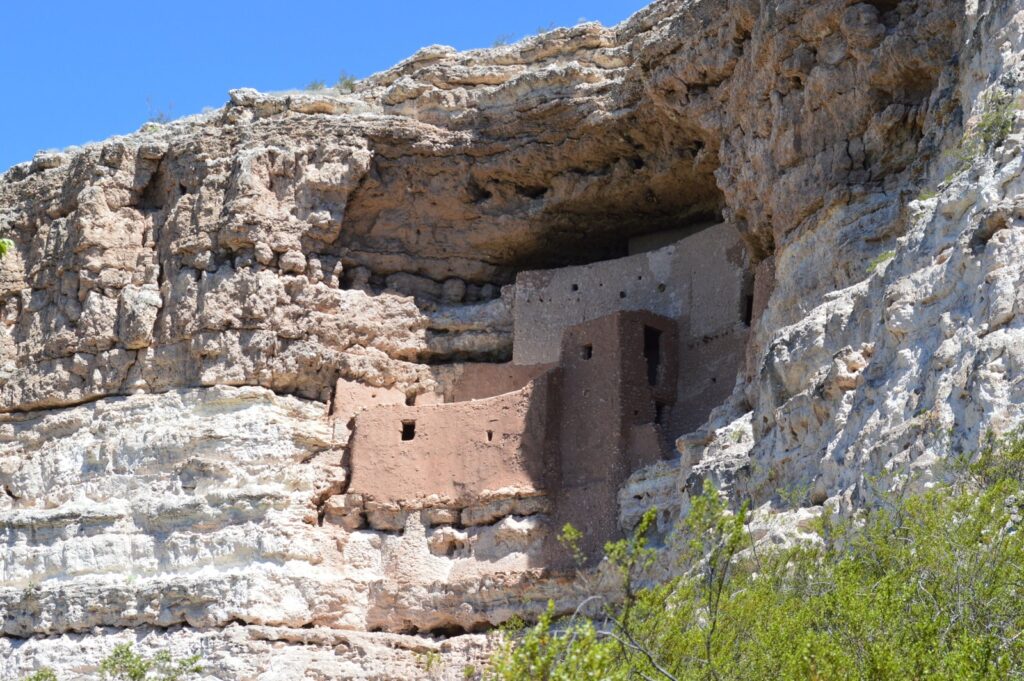
Updated November 2026. Montezuma Castle is a five-story cliff dwelling set into a limestone cliff above Beaver Creek in Camp Verde, and the National Park Service counts it among the country’s first four national monuments. Eleven miles away, Montezuma Well is a spring-fed sinkhole ringed by cliff rooms, a thousand-year-old irrigation canal and a creekside trail that runs noticeably cooler than the rim. The two sites make up Montezuma Castle National Monument, and you can see both in a morning.
This guide covers what you’ll see and who built it, according to the National Park Service, plus 2026 hours, fees and passes, holiday closures, how to get there from Sedona, Cottonwood and Camp Verde, how much time to plan, trail accessibility, the rules for dogs, and what to pair the visit with in Camp Verde.
Flood note (November 2026): A National Weather Service flash flood warning on Nov. 1 listed Montezuma Castle National Monument, Montezuma Well, Rimrock and McGuireville among the affected areas. As of Nov. 27, the National Park Service had posted no flood closure for either the Castle or the Well. Check the park’s alerts page before you go.
Montezuma Castle and Montezuma Well at a glance
- Hours: Both sites are open daily, 9 a.m. to 4:45 p.m., per the NPS.
- Closed: Thanksgiving, Christmas Day and New Year’s Day (next up: Dec. 25 and Jan. 1). The park may close early on Dec. 24, Dec. 31 and the day before Thanksgiving.
- Fees: Montezuma Castle is $10 per adult 16 and older, and kids 15 and under are free. The ticket also covers Tuzigoot National Monument in Clarkdale for seven days. Montezuma Well is free.
- Where: Montezuma Castle is at 2800 Montezuma Castle Road, Camp Verde, off I-17 exit 289. Montezuma Well is off exit 293, through McGuireville and Rimrock.
- Time: The NPS says most people spend about 30 minutes at the Castle and about 45 minutes at the Well, and the drive between them takes about 20 minutes.
- Phone: 928-567-3322. The park’s current alert says staff can’t check voicemail at the visitor center and calls are routed to Tuzigoot; you can also email moca_tuzi_info@nps.gov.
What Montezuma Castle is
Montezuma Castle sits in an alcove about 90 feet up a south-facing cliff. The NPS describes it as a 20-room “high-rise apartment” that housed more than one family, not a castle and not a single household. By the park’s estimate, the building had room for about 35 people, or two or three families at most, while the wider community around it, including a larger pueblo called Castle A, other cliff rooms and pit houses, held about 150 to 200 people at its peak.
Construction began in the 1100s. (The park’s FAQ says around 1100 CE; its trail page says around 1150.) People reached the rooms, and moved between floors, by ladder. The NPS says more than 95 percent of what you see today is original, with some stabilization over the years, and credits its sheltered spot in the cliff alcove for keeping it intact. Look to the right of the central tower for the vigas, the wooden roof beams sticking out of the wall, which the park says are original. Repairs are visible along the top wall of the fifth floor.
Why build so high? The park lists several likely reasons that probably worked together. The south-facing cliff keeps the rooms warmer in winter and cooler in summer. The height kept homes above Beaver Creek’s floods while keeping water close. A high perch made it easier to see travelers coming and to signal neighboring villages, and it helped keep rodents out of stored food.
Castle A
Along the same trail is Castle A, a pueblo the NPS says was about twice the size of Montezuma Castle, with 45 to 50 rooms. It was excavated in 1933, and the park says the finds greatly expanded what’s known about the people who lived along Beaver Creek. Per the NPS, Castle A burned sometime between 1375 and 1395, amid a dispute between its residents and the Apache and Yavapai. Today you’ll see stonework and rooms cut into the cliff behind it.
Who built it: the Sinagua
Archaeologists call the builders the Sinagua (pronounced sin-AH-wa), from the Spanish “sin agua,” or “without water.” Despite the name, the NPS notes, the Sinagua had plenty of water. Archaeologist Harold S. Colton chose it in 1939 after the San Francisco Peaks near Flagstaff, which early Spanish explorers called the “sierra sin agua” because they had no rivers, according to the NPS. The Hopi call these people the Hisatsinom, meaning “ancient ones,” and the park notes we don’t know what they called themselves.
Archaeologists divide the culture, the NPS explains, into the Northern Sinagua around Flagstaff, whose homes are preserved at Wupatki and Walnut Canyon, and the Southern Sinagua of the Verde Valley, whose homes are preserved here and at Tuzigoot. The park says Sinagua people were in the valley by about 650 CE, first living in pithouses dug partly into the ground, and began building pueblos and cliff dwellings around 1050 CE. They left behind undecorated pottery, finely woven cotton textiles and their architecture, and they traded for goods from outside the valley.
By about 1400 CE, they had moved on. The park says the reason isn’t known; its list of possibilities includes competition for resources, which its FAQ calls the most likely, along with climate change, conflict, the collapse of trade routes and religious reasons. The NPS stresses that the Sinagua didn’t disappear. Some Hopi clans consider them ancestors, and in Hopi traditional knowledge these villages were a multi-generational stop on a longer journey. Some Yavapai-Apache say not all Sinagua left and that some joined the Yavapai and Apache. The monument is affiliated today with tribes including the Four Southern Tribes of Arizona, the Yavapai, Apache, Hopi and Zuni.
Why it’s called Montezuma Castle
The name is a mistake. When Spanish travelers passed through in the late 1500s, they assumed the Aztecs had built the empty dwellings, and European Americans gave this one the Aztec emperor’s name in the 1860s, the NPS says. Moctezuma II ruled from 1502 to 1520, after the Sinagua had already left, and the park says there’s no evidence he or the Aztecs ever came to the Verde Valley.
One of the first national monuments
President Theodore Roosevelt proclaimed Montezuma Castle a national monument on Dec. 8, 1906, the same year Congress passed the Antiquities Act. The NPS counts it among the nation’s first four; Devils Tower in Wyoming had come first that September. Roosevelt called it a place “of the greatest ethnological value and scientific interest.” The NPS notes that looters had already stripped most artifacts from the building by then. Early visitors climbed ladders up the cliff and into the rooms, but the damage led the park to end public access in 1951. Visitors could go into part of Castle A until 1978. If you want to see inside, a five-minute virtual tour plays on a loop in the visitor center, and it’s also online.
What Montezuma Well is
Montezuma Well is a separate unit of the same monument, about 11 miles northeast of the Castle. It’s a collapsed limestone sinkhole holding more than 15 million gallons of water in a place that gets less than 13 inches of rain a year. The NPS explains that the water fell as rain and snow on the Mogollon Rim more than 10,000 years ago and seeped slowly through rock until it met a buried wall of volcanic basalt, which works like a dam and forces it upward. Over time it carved out a cavern whose roof collapsed, leaving the sinkhole you see. The park says 1.5 million gallons of new water flows in every day, then spills out through a slender cave in the rim’s southeast side and emerges at the outlet beyond.
The water is high in dissolved carbon dioxide and arsenic, so fish can’t live in it. Instead, the NPS says, five species have evolved here that live nowhere else. They include a tiny shrimp-like amphipod, a leech that eats amphipods rather than drinking blood, a water scorpion, the Montezuma Well springsnail and a diatom. The park describes a nightly chase: leeches rise from the depths after dark, and the amphipods flee to the edges, where water scorpions wait.
People have used the Well for a very long time. The NPS points to a pithouse dated to around 1050 CE, probably Hohokam, and to an irrigation canal, about a thousand years old, that took water from the outlet and stretched for miles to fields of corn, beans and squash. By the 1100s, Sinagua builders were adding small cliff rooms around the rim, eventually more than 30, and the park says their pueblo was one of 40 to 60 villages along the valley’s waterways. They had moved on by 1425. According to the park, ancestors of the Hopi, Zuni and Yavapai appear in those tribes’ oral histories of this place, the Western Apache have honored the landscape for centuries, and the site is still considered sacred by many local tribes.
There’s ranch history too. Wales and Jennie Arnold settled here in 1870 and ran a mail station, using the old canal to water their land, the NPS says. The Back family later owned the land for more than 60 years and turned the Well into a tourist stop, with tours, boat rides on the water and a resort. Congress approved buying the land in 1943, and it joined the park system in 1947. You can still see the canal and the historic Back ranch house.
Montezuma Castle hours in 2026
Per the NPS, Montezuma Castle and Montezuma Well are both open every day from 9 a.m. to 4:45 p.m. A few details matter at the Castle:
- The entrance gate is about a mile before the visitor center (the NPS says 0.8 mile from gate to parking lot). The NPS hours listing says it closes at 4:45 p.m.; its visitor center listing says the gate locks at 5 p.m. The park says entry after hours isn’t allowed, and parking on the road or in front of the gate is never allowed.
- The visitor center has the fee station, restrooms, a small museum and a Western National Parks Association bookstore.
- The loop trail closes for 30 minutes after any lightning strike within five miles, per the park. Afternoon monsoon storms are common from July through mid-September.
Holiday closures
The NPS lists both units as closed on Thanksgiving, Christmas Day (Friday, Dec. 25, 2026) and New Year’s Day (Friday, Jan. 1, 2027). The visitor center listing adds that the park may close early on Dec. 24, Dec. 31 and the day before Thanksgiving. Early-closing times for Christmas Eve and New Year’s Eve 2026 hadn’t been posted when we checked, so call or check the park’s site before going on those days.
Fort Verde State Historic Park is also closed on Christmas Day, and Out of Africa Wildlife Park says it closes only on Thanksgiving and Christmas Day. For everything else that’s open or closed over the holidays, see our Christmas and New Year’s in the Verde Valley 2026 guide.
Montezuma Castle fees and passes
- Standard entrance: $10 per adult 16 and older, per the NPS. It’s good for seven days at both Montezuma Castle and Tuzigoot National Monument. Kids 15 and under are free. The park says the seven-day pass can be upgraded to an annual or lifetime pass within seven days of purchase.
- Montezuma Well: free. There’s no entrance fee.
- Montezuma Castle annual pass: $35 for a year at both Montezuma Castle and Tuzigoot. It covers the cardholder and three adult guests and is sold at either park or on Recreation.gov.
- America the Beautiful passes: accepted. At per-person sites like this one, a pass covers the holder and three adults 16 and older. The NPS lists the Annual Pass at $80 for U.S. residents and $250 for non-residents, the Senior Annual Pass at $20 and Senior Lifetime Pass at $80 for U.S. citizens and residents 62 and older, and free passes for current military and dependents, Gold Star families and veterans, people with permanent disabilities (the Access Pass, available at the Montezuma Castle visitor center) and fourth graders. Bring photo ID.
- Free entrance days: All of the 2026 free entrance days listed by the NPS have passed. The last was Veterans Day, Nov. 11.
Passes are non-refundable and non-transferable, and the park can’t replace them if lost.
Getting there
From Camp Verde
Take I-17 to exit 289. The NPS says to drive east through two traffic circles for about half a mile to the blinking red light, then turn left onto Montezuma Castle Road. Note that you can’t see the Castle from any road, so don’t expect a roadside glimpse.
From Sedona
The most direct route is SR 179 south to I-17 at exit 298, then south on I-17 to exit 289. You can also go through Cottonwood: Out of Africa’s directions describe taking SR 89A southwest through West Sedona toward Cottonwood, then turning onto SR 260 toward Camp Verde.
From Cottonwood
Take SR 260 southeast toward Camp Verde to I-17 at exit 287, then head north on I-17 to exit 289. Coming from Cottonwood, it’s easy to add Tuzigoot in Clarkdale (and a meal from our Clarkdale restaurant guide) to the same day, since one ticket covers both monuments. Our things to do in Cottonwood guide covers the rest of that side of the valley.
To Montezuma Well
From the Castle, the NPS says to go north on I-17 four miles to exit 293, then follow the signs through McGuireville and Rimrock for four miles to the entrance. Paved roads go all the way there. The park warns that GPS may route you onto rough, unmaintained forest roads that rain can close, and says low-clearance cars, RVs and buses should stay on pavement.
How much time to plan
The park’s FAQ says most visitors spend about 30 minutes at the Castle and about 45 minutes at the Well, including the full loop, with a 20-minute drive between. By our math, two to three hours covers both, a little more if you watch the visitor center’s virtual tour or picnic. The Castle has a picnic area along Beaver Creek, which the NPS calls one of only a few perennial streams in Arizona. The Well has a picnic area with flush toilets.
The park doesn’t sell bottled water. There’s a refill station at the Castle visitor center (the bookstore sells bottles) and another at the Well’s picnic area. NPS weather notes put summer highs between 95 and 115 degrees, while winter highs average around 55 and lows can drop into the teens. Snow is rare.
The Montezuma Well trail
The Well is more of a walk than the Castle, and it has stairs. The NPS lists four trails:
- Main Well Loop (0.3 mile, moderate): The loop begins and ends at the parking lot. Of its 54 stairs, 43 are the climb from the ranger station up to the overlook, where the footing is natural, uneven rock with steps as tall as two feet; expect ice or wet spots in some seasons. A steep grade leads down from the rim toward the Outlet Trail.
- Swallet Trail (150 yards): From the overlook, this spur descends roughly 80 feet into the Well on 116 stairs without handrails. From here you can look into a cave that holds Sinagua dwellings. Visitors can’t go inside; the park says the Swallet Cave is home to bats that are vulnerable to white-nose syndrome.
- Outlet Trail (85 yards): 49 stairs, some uneven and none with handrails, lead down to the creek, where water leaves the Well through a prehistoric irrigation canal. The NPS says it can be up to 20 degrees cooler here than on the rim, which is welcome in summer.
- Pasture Trail (0.58 mile, easy): A flat, unpaved trail at the back of the picnic area, half wood chips and half dirt.
Accessibility
Montezuma Castle is the easy one. Per the NPS, the visitor center and the 0.3-mile loop are wheelchair- and stroller-accessible, fully paved, with little elevation change and plenty of benches and some shade. The Castle itself is about 100 yards from the visitor center. Castle A is about 160 yards out on the far side of the loop, and the short, paved spur to it has a grade the NPS says may not suit wheelchairs.
Montezuma Well is harder. The NPS says none of its trails are wheelchair-accessible, and the only ADA-accessible facility at the Well is the set of flush toilets by the picnic area. A mostly flat 175-yard stretch between the restrooms and the Outlet stairs works for a wheelchair or stroller but has no view of the Well. A large-wheeled stroller may manage the Pasture Trail.
The parks don’t loan wheelchairs, so bring any mobility aids you need. If you need a sign language interpreter for a park event, the NPS asks for at least two weeks’ notice.
Can you bring your dog to Montezuma Castle?
Yes. Leashed pets are welcome on the trails at both the Castle and the Well, plus paved roads, parking lots, picnic areas and the Horse Pasture at the Well, per the NPS. The leash can’t be longer than six feet, and you must pick up after your dog. Pets aren’t allowed in visitor centers (except during check-in), contact stations or restrooms. Service dogs can go anywhere people can, and the park notes that emotional support animals aren’t service animals.
The parking lots have no shade, and the NPS warns that car temperatures can top 140 degrees in summer, so never leave a pet in the car. The park recommends dog boots in summer and suggests a “seven second rule”: if you can’t hold the back of your hand on the pavement for seven seconds, it’s too hot for paws. Rattlesnakes (Western diamondback and black-tailed) are common in warm months, and sacred datura, a native plant with big white trumpet-shaped flowers that the NPS says is common in the warm season, is toxic to people and pets.
Ask at the visitor center about the BARK Ranger program, which certifies dogs for both Montezuma Castle and Tuzigoot. Keep in mind that Out of Africa Wildlife Park doesn’t allow pets or service animals inside, so plan accordingly if you’re pairing the two.
Visiting with kids
Kids can pick up a Junior Ranger book at the Castle visitor center or the Well’s ranger station, per the NPS. Ranger programs depend on staffing, so ask at the visitor center, or call 928-567-3322 or email moca_tuzi_info@nps.gov. Rules to cover beforehand: stay on the paved trail, don’t climb or sit on any walls, leave plants, rocks and artifacts where they are, and no drones.
What to pair it with in Camp Verde
Fort Verde State Historic Park
Fort Verde, in Camp Verde’s historic downtown, was a base for Gen. Crook’s Army scouts and soldiers in the 1870s and 1880s. Arizona State Parks calls it the best-preserved example of an Indian Wars-period fort in Arizona. Three historic house museums are furnished in the 1880s period, and the former administration building is now the visitor center. Hours are 9 a.m. to 4:30 p.m. daily. Admission is $10 for adults 14 and older, $5 for ages 7 to 13, and free for children 6 and under. Holiday hours are 9 a.m. to 2 p.m. on Christmas Eve, and the park is closed Christmas Day. “A Victorian Christmas at Fort Verde” runs Saturday, Dec. 19, 2026, from 10 a.m. to 8 p.m. For more on the fort and the rest of town, see our guide to things to do in Camp Verde.
Out of Africa Wildlife Park
Out of Africa is at 3505 W. SR 260, about 3 miles west of I-17 exit 287. The park says it covers more than 100 acres and is home to hundreds of exotic mammals, birds and reptiles. It’s open daily from 9:30 a.m. to 5 p.m., the admissions window closes at 4 p.m., and it closes only on Thanksgiving and Christmas Day. Its general information line is 928-567-2840. Because the Castle closes at 4:45 p.m. and Out of Africa’s ticket window closes at 4 p.m., start with the Castle in the morning and head to the wildlife park after lunch.
Tuzigoot National Monument
Your Montezuma Castle ticket also gets you into Tuzigoot for seven days. It’s the other Verde Valley monument that protects Southern Sinagua homes, per the NPS, and it’s in Clarkdale, near Cottonwood.
Where to eat
We found no food service at the monument, so plan to eat in Camp Verde. The historic downtown blocks along Main Street and Hollamon Street, near Fort Verde, have most of the choices: Moscato Italian Restaurant, Wingfield Bread Company’s sourdough bakery, Astoria International Bistro’s Eastern European menu, Mexican food with a full bar at La Casita, and coffee at Thanks A Latte. Closer to the Castle exit, Babe’s Round Up serves barbecue on Montezuma Castle Highway, and Beto’s Corner on Cliff House Drive serves burgers and breakfast burritos all day. Hours vary and several aren’t published, so see our Camp Verde restaurant guide for addresses, details and what to call ahead about.
A sample day
- Arrive at Montezuma Castle at 9 a.m. opening, walk the loop and watch the virtual tour.
- Drive 20 minutes to Montezuma Well, walk the loop and go down to the Outlet.
- Have lunch on Main Street in Camp Verde.
- Spend the afternoon at Fort Verde (until 4:30 p.m.) or Out of Africa (admission until 4 p.m.).
For what’s on the weekend you visit, check our Verde Valley this weekend page and the events calendar.
Where to stay nearby
Camp Verde sits between Sedona and Cottonwood, so a base in any of the three works for a Montezuma Castle trip. The map below shows hotels and rentals around Camp Verde with current prices.
Open the full-size map. Map and prices provided by Stay22. If you book through this map, we may earn a small commission at no extra cost to you. It doesn’t affect what we recommend. See our disclosure policy.
Frequently asked questions
How much does it cost to visit Montezuma Castle?
Per the National Park Service, it’s $10 per adult 16 and older, and kids 15 and under are free. The ticket is good for seven days at both Montezuma Castle and Tuzigoot National Monument. America the Beautiful passes are accepted.
Is Montezuma Well free?
Yes. The NPS charges no entrance fee at Montezuma Well, which is a separate unit of Montezuma Castle National Monument about 11 miles away.
What are Montezuma Castle’s hours?
Montezuma Castle and Montezuma Well are open daily from 9 a.m. to 4:45 p.m., per the NPS. Both are closed on Thanksgiving, Christmas Day and New Year’s Day, and the park may close early on Dec. 24 and Dec. 31.
Is Montezuma Castle open on Christmas Day?
No. The NPS lists both Montezuma Castle and Montezuma Well as closed on Dec. 25, 2026, and on New Year’s Day, Jan. 1, 2027.
Can you go inside Montezuma Castle?
No. Public access ended in 1951 to protect the fragile structure, and the NPS says it’s also unsafe. You view it from the paved loop trail, and a five-minute virtual tour of the interior plays in the visitor center.
How long does it take to see Montezuma Castle and Montezuma Well?
The NPS says most people spend about 30 minutes at the Castle and about 45 minutes at the Well, with about a 20-minute drive between them. By our math, two to three hours covers both.
Who built Montezuma Castle?
The Sinagua, whom the Hopi call the Hisatsinom, began building it in the 1100s, according to the NPS. The Aztecs and Montezuma had no connection to it; per the NPS, Spanish travelers in the late 1500s assumed the Aztecs built the Verde Valley’s dwellings, and European Americans attached Montezuma’s name in the 1860s.
Are dogs allowed at Montezuma Castle?
Yes, on a leash no longer than six feet, on the trails, parking lots and picnic areas at both the Castle and the Well. Pets aren’t allowed in the visitor center except during check-in.
Is the Montezuma Castle trail wheelchair-accessible?
Yes. The 0.3-mile loop is paved and wheelchair-accessible, per the NPS, although the NPS says the short spur to Castle A has a grade that may not suit wheelchairs. The trails at Montezuma Well aren’t wheelchair-accessible and include stairs.
How do you get to Montezuma Castle from Sedona?
Take SR 179 south to I-17 at exit 298, then I-17 south to exit 289. From the exit, the NPS says it’s about half a mile east to Montezuma Castle Road and then 0.8 mile from the entrance gate to the parking lot.
Sources: National Park Service pages for Montezuma Castle National Monument, including fees, directions, accessibility, pets, FAQ, the Sinagua and Exploring Montezuma Well, plus NPS operating-hours data; Arizona State Parks (Fort Verde); and Out of Africa Wildlife Park. Checked Nov. 27, 2026. Featured photo: Montezuma Castle, NPS photo (public domain).